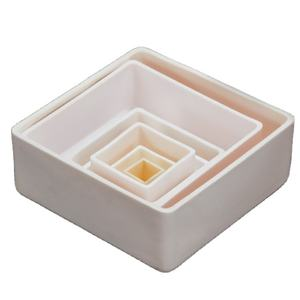
Professional Premium Aluminum Oxide Products Supplier


(Al2O3 Alumina High Precision Wear and Corrosion Resistance Ceramic Block Brick Tile)
1. Why Al2O3 Alumina Ceramic Tiles Have Exceptional Characteristics
1.1 Inherent Material Properties
Al₂O₃ alumina ceramics derive their superior performance from atomic-level characteristics. With a Vickers hardness of 15-19 GPa, they outperform most metals in wear resistance. The strong ionic-covalent bonds create chemical inertness, resisting acids and alkalis up to 1600°C. This combination makes them virtually impervious to abrasive wear and chemical degradation. Their thermal stability prevents deformation under extreme temperature fluctuations, maintaining dimensional precision in harsh environments.
1.2 Structural Advantages
High-purity alumina (>95%) forms dense, non-porous microstructures during sintering, eliminating pathways for corrosive penetration. This density (3.7-3.9 g/cm³) contributes to exceptional compressive strength (>2000 MPa), enabling load-bearing capabilities in structural applications. The homogeneous grain structure ensures uniform wear distribution, significantly extending service life compared to polymer or metal alternatives.
2. What Are Al₂O₃ Alumina Precision Ceramic Components?
2.1 Technical Definition
Al₂O₃ alumina wear-resistant ceramics are engineered components manufactured from aluminum oxide powders (>90% purity) through high-temperature processing. Available as blocks, bricks, or tiles, they feature dimensional tolerances within ±0.1mm for precision installations. These components are characterized by their crystalline structure, which can be fine-tuned during manufacturing for specific mechanical properties.
2.2 Material Grades and Forms
Commercial grades include:
– 92-95% Al₂O₃: Cost-effective for moderate wear
– 99% Al₂O₃: Premium corrosion resistance
– 99.5% Al₂O₃: Ultra-high purity for extreme conditions
Forms range from standardized guide blocks to custom-engineered grating plates, with surface finishes from as-fired to precision-ground (Ra ≤ 0.4μm).
3. Production Process of Alumina Ceramic Components
3.1 Advanced Manufacturing Stages
Production begins with high-purity α-alumina powder milling to submicron particle sizes. Binders and sintering aids are added before:
– Dry pressing for simple shapes
– Isostatic pressing for complex geometries
– Injection molding for intricate designs
Green bodies undergo controlled bisque firing (800-1000°C) before final sintering at 1500-1650°C, achieving >98% theoretical density.
3.2 Precision Finishing Techniques
Post-sintering processes include:
– Diamond grinding for dimensional accuracy (±0.05mm)
– Lapping for surface refinement
– Laser drilling for custom apertures
– Ultrasonic machining for complex features
Quality verification involves coordinate measuring machines (CMM), ultrasonic flaw detection, and metallographic analysis to ensure defect-free microstructure.
4. Application Fields of Alumina Ceramics
4.1 Industrial Wear Solutions
In mining and material handling, alumina tiles line chutes, hoppers, and transfer points, extending equipment life 3-5× over steel. Power plants utilize them in ash handling systems where abrasion and corrosion coexist. The cement industry employs these ceramics in cyclone separators and kiln inlet ducts, withstanding constant abrasive flows at 800°C+ temperatures.
4.2 Specialized Engineering Applications
High-purity alumina serves in:
– Chemical processing: Reactor linings resisting acid hydrolysis
– Petrochemical: Wear plates in catalytic cracking units
– Food processing: Non-contaminating baking surfaces
– Semiconductor: Wafer-handling components
– Energy: Insulating components in fuel cells
5. Selecting Quality Alumina Ceramic Components
5.1 Performance Criteria
Prioritize these specifications:
– Al₂O₃ content (≥95% for industrial use)
– Bulk density (>3.7 g/cm³)
– Flexural strength (>300 MPa)
– Fracture toughness (≥4 MPa·m¹/²)
– Surface roughness (Ra ≤ 0.8μm for sliding surfaces)
Verify certifications like ISO 9001 and material test reports for traceability.
5.2 Design and Validation Considerations
For critical applications:
– Request finite element analysis (FEA) of stress distribution
– Validate thermal shock resistance (ΔT > 200°C)
– Confirm impact resistance (≥3 J/cm²)
– Require wear testing data under simulated conditions
Manufacturers should provide CAD support for custom grinding plates and installation engineering guidance.
6. Common Questions About Alumina Ceramics
6.1 Performance and Compatibility
Q: How do alumina ceramics compare to silicon carbide in corrosion resistance?
A: While SiC offers superior acid resistance, alumina outperforms in alkaline environments and provides better impact resistance at lower cost.
Q: Can alumina tiles withstand thermal cycling?
A> Yes, grades like 99.5% Al₂O₃ tolerate rapid ΔT > 250°C due to controlled grain boundaries and microcrack management.
6.2 Installation and Maintenance
Q: What bonding methods ensure secure installation?
A> Epoxy systems (150°C max) or refractory mortars (to 1600°C) are used, with mechanical interlocking (dovetails, bolts) for high-impact zones.
Q: Do alumina ceramics require special maintenance?
A> They’re virtually maintenance-free but benefit from periodic inspections for substrate integrity. Cleaning requires only water or mild solvents – avoid hydrofluoric acid.
Tags: Al2O3 alumina ceramic, wear resistant tile, corrosion resistant brick, precision ceramic block, industrial ceramic liner, alumina grinding plate, high temperature ceramic, ceramic wear parts

(Al2O3 Alumina High Precision Wear and Corrosion Resistance Ceramic Block Brick Tile)
Supplier
Alumina Technology Co., Ltd focus on the research and development, production and sales of aluminum oxide powder, aluminum oxide products, aluminum oxide crucible, etc., serving the electronics, ceramics, chemical and other industries. Since its establishment in 2005, the company has been committed to providing customers with the best products and services.
RELATED POSTS
How to Use and Care for Your Alumina Ceramic Baking Dish: A Practical Guide

Is Alumina Ceramic Better Than Regular Ceramic for Baking Dishes?
5 Niche Uses of Alumina Ceramic Baking Dishes Beyond the Kitchen

How to Choose the Best Alumina Ceramic Baking Dish for Your Kitchen

Alumina Ceramic Baking Dishes Outperform Traditional Cookware in Heat Retention and Durability