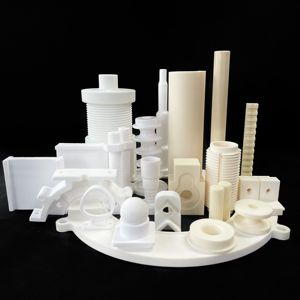
Professional Premium Aluminum Oxide Products Supplier


(Customized Alumina Ceramic Block High-Temperature Resistant Wear-Resistant Insulating Plate Al2O3 Ceramic Heating Ceramic Parts)
1. Why Customized Alumina Ceramic Parts Exhibit Superior Characteristics
Customized alumina ceramic (Al₂O₃) components deliver exceptional performance due to their inherent material properties. The high ionic bonding of aluminum oxide creates an extremely stable crystalline structure, enabling unmatched thermal stability up to 1750°C. This atomic arrangement also yields remarkable hardness (9 on Mohs scale), significantly outperforming metals in abrasive environments. The material’s low thermal conductivity (30-35 W/mK) provides superior insulation capabilities, while its dielectric strength (15-30 kV/mm) prevents electrical conduction even at extreme temperatures. Unlike polymer composites, alumina ceramics maintain dimensional stability during thermal cycling due to near-zero thermal expansion. These properties are further enhanced through precision customization, allowing manufacturers to optimize grain size (typically 3-20µm) and density (≥3.9 g/cm³) for specific thermal, mechanical, or electrical requirements.
2. Defining Customized Alumina Ceramic Functional Components
Customized alumina ceramic blocks are precision-engineered Al₂O₃ components designed for extreme environments requiring thermal management, wear resistance, and electrical insulation. These technical ceramics typically contain 92-99.9% aluminum oxide, with purity levels determining specific performance characteristics. The “heating ceramic” designation refers to specialized formulations that withstand direct exposure to heating elements while maintaining electrical isolation. As high-temperature insulating plates, they prevent thermal transfer between system components, while their wear-resistant properties stem from extreme surface hardness. Customization encompasses dimensional precision (±0.1% tolerance), surface finish (Ra 0.2-0.4µm), and specialized features like mounting holes, grooves, or unique geometries tailored to specific industrial applications.
3. Manufacturing Process of Custom Alumina Ceramic Components
3.1 Advanced Forming Techniques
Production begins with high-purity α-alumina powder (≤0.5µm particle size) mixed with sintering aids and binders. Custom shapes are formed using isostatic pressing (for complex geometries), injection molding (high-volume production), or tape casting (thin plates). The forming method determines dimensional accuracy and surface quality, with isostatic pressing achieving densities up to 65% of theoretical value before sintering.
3.2 Precision Sintering
Green parts undergo controlled thermal processing in high-temperature furnaces (1600-1800°C). This critical phase eliminates binders and achieves final densification through diffusion bonding. Sintering profiles are customized based on part geometry and performance requirements, with heating rates of 1-5°C/min and dwell times of 2-4 hours ensuring uniform microstructure development without warping.
4. Application Fields of Custom Alumina Ceramic Components
These specialized ceramics serve critical functions across multiple industries due to their unique properties. In semiconductor manufacturing, they function as wafer handling arms and plasma-resistant components. Thermal processing industries utilize them as furnace setters, kiln furniture, and heat baffles operating above 1500°C. Their electrical insulation properties make them ideal for high-voltage insulators in power transmission systems. Within industrial machinery, alumina plates serve as wear liners in mining equipment and pump seals in chemical processing. The food technology sector employs them in high-temperature cooking surfaces, while laboratories use custom alumina components as sample holders in analytical instruments. Emerging applications include rocket engine insulation and medical implant coatings.
5. Selection Criteria for Quality Alumina Ceramic Parts
5.1 Material Specifications
Prioritize alumina purity (95-99.8%) based on application requirements: higher purity enhances corrosion resistance but increases brittleness. Verify density (≥3.75 g/cm³) and porosity (<5%) through material certifications. For thermal applications, confirm thermal shock resistance parameters (ΔT > 200°C) and coefficient of thermal expansion (8×10⁻⁶/K).
5.2 Performance Validation
Require documented testing including hardness measurements (≥85 HRA), dielectric strength (≥15 kV/mm), and wear resistance data (ASTM G65 testing). For critical applications, request microstructure analysis showing uniform grain distribution. Validate dimensional tolerances (±0.1mm or better) and surface finish specifications. Reputable manufacturers provide ISO 9001 certification and material test reports.
6. Common Questions About Alumina Ceramic Functional Components
6.1 Thermal Performance Queries
Users frequently ask about maximum continuous operating temperatures (typically 1650-1750°C for 99% Al₂O₃) and thermal cycling limits. Properly sintered alumina withstands thousands of cycles between room temperature and 1000°C without degradation. Another common concern involves thermal conductivity – alumina’s intermediate conductivity (30-35 W/mK) makes it ideal for applications requiring thermal insulation rather than heat spreading.
6.2 Customization and Maintenance
Manufacturers regularly address questions about minimum feature sizes (≥0.5mm for pressed parts), lead times for custom geometries (typically 4-8 weeks), and post-processing capabilities. Regarding maintenance, alumina components require no special treatment beyond avoiding mechanical impact and thermal shocks exceeding rated ΔT values. Proper handling prevents edge chipping, the most common failure mode.
Tags: alumina ceramic block, Al2O3 ceramic parts, high temperature ceramic plate, custom ceramic components, alumina heating element, ceramic insulator plate, wear-resistant alumina, technical ceramic fabrication, alumina ceramic applications

(Customized Alumina Ceramic Block High-Temperature Resistant Wear-Resistant Insulating Plate Al2O3 Ceramic Heating Ceramic Parts)
Supplier
Alumina Technology Co., Ltd focus on the research and development, production and sales of aluminum oxide powder, aluminum oxide products, aluminum oxide crucible, etc., serving the electronics, ceramics, chemical and other industries. Since its establishment in 2005, the company has been committed to providing customers with the best products and services.
RELATED POSTS
Alumina Ceramic Baking Dishes Are Revolutionizing High-Temperature Laboratory Sample Preparation
How to Choose the Right Alumina Ceramic Baking Dish for Your Kitchen
Custom-Sized Wearable Al₂O₃ Ceramic Insulating Plates, Sheets, and Blocks
How to Safely Use and Maintain Your Alumina Ceramic Baking Dish: A Practical Guide

Alumina Ceramic Baking Dishes Are Revolutionizing High-Temperature Laboratory Crucibles