Professional Premium Aluminum Oxide Products Supplier

1. Introduction
When you hear ‘alumina ceramic baking dish,’ your mind probably jumps to holiday casseroles or artisanal butter dishes. But in advanced materials labs and high-temperature processing facilities, this humble-looking vessel plays a surprisingly vital role. Thanks to its composition—typically 95–99.8% aluminum oxide (Al₂O₃)—the alumina ceramic baking dish offers unmatched thermal shock resistance, chemical inertness, and structural integrity at temperatures exceeding 1,600°C (2,912°F).

This article dives into a niche but practical application: using alumina ceramic baking dishes as makeshift or purpose-built crucibles and melting dishes in laboratory and small-scale industrial settings. Forget dinner plates—here, the alumina ceramic dish is a workhorse for precision materials processing.
2. Why Alumina Ceramic Excels in High-Temperature Environments
Alumina ceramics are engineered for extreme conditions. Unlike standard stoneware or porcelain, high-purity alumina maintains its shape and composition even when exposed to molten metals, aggressive fluxes, or repeated thermal cycling.
Key advantages include:
- Exceptional thermal stability up to 1,750°C
- Near-zero reactivity with most molten metals (including gold, silver, and aluminum)
- High mechanical strength and hardness (9 on the Mohs scale)
- Excellent electrical insulation properties
- Non-porous surface that resists contamination
3. Real-World Application: Melting Precious Metals in a Lab Setting
One of the most compelling niche uses of an alumina ceramic baking dish is as a melting dish for small-batch precious metal refining. Jewelers, metallurgists, and university researchers often repurpose shallow alumina ceramic casserole dishes or ramekins to melt gold, silver, or platinum alloys.
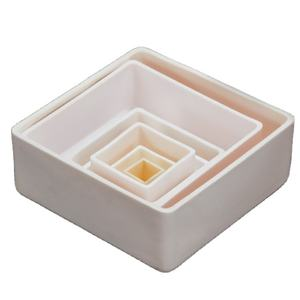
Unlike graphite or silica crucibles, alumina doesn’t introduce carbon or silicon impurities. This is crucial when purity affects material properties or assay results. An alumina ceramic melting dish—essentially a flat-bottomed alumina ceramic baking dish—provides even heat distribution and easy pouring due to its smooth, sloped sides.
For instance, a researcher synthesizing gold nanoparticles might use an alumina ceramic butter dish with lid to contain the melt under inert atmosphere, minimizing oxidation while ensuring no ceramic fragments contaminate the sample.
4. Beyond Melting: Synthesis and Annealing Applications
Alumina ceramic dishes also serve as substrates or containment vessels in ceramic and glass synthesis. Their flat geometry—similar to alumina ceramic plates for painting or alumina white ceramic plates—makes them ideal for spreading thin layers of precursor powders during solid-state reactions.
In annealing processes, alumina ceramic serving platters or large alumina ceramic casserole dishes with lids can hold multiple samples uniformly, preventing cross-contamination. The non-reactive surface ensures that delicate oxide compounds (like perovskites or ferrites) form without interference from the container.
Even alumina ceramic childrens plates—when made from high-purity alumina—have been used in educational labs to demonstrate high-temp reactions safely, thanks to their durability and thermal shock resistance.
5. Practical Considerations When Substituting Kitchenware for Labware
Not all ‘alumina ceramic baking dishes’ are created equal. Commercial kitchen versions labeled as ‘alumina baking ceramic dish’ may contain glazes, colorants, or lower-purity alumina that degrade above 1,000°C.
For lab use, ensure the dish is:
- Unglazed and made from ≥95% Al₂O₃
- Free of decorative elements (e.g., alumina christmas ceramic platter designs often use low-temp glazes)
- Sourced from technical ceramics suppliers, not general kitchenware brands (note: ‘alumina baking dish staub’ refers to enameled cast iron, not true alumina ceramic)
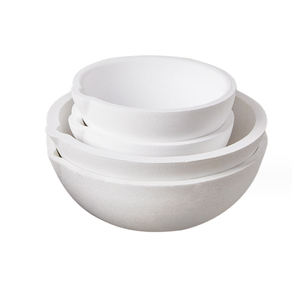
True lab-grade alumina ceramic dishes for oven use should resemble industrial alumina crucibles—dense, white or off-white, and devoid of aesthetic finishes.
6. Comparison to Standard Lab Crucibles
While purpose-built alumina crucibles (like cylindrical alumina ceramic crucible with lid) are ideal, a shallow alumina ceramic casserole dish offers advantages in specific scenarios:
- Wider surface area for faster evaporation or oxidation control
- Easier visual monitoring of reactions
- Lower cost for disposable or single-use applications
However, for deep melts or high-volume processing, traditional alumina crucible designs remain superior. Still, in resource-limited settings—such as field labs or startup material studios—the versatility of an alumina oven ceramic dish can’t be overstated.
7. Conclusion
The alumina ceramic baking dish transcends its culinary origins in high-performance technical applications. From melting gold in a research lab to annealing advanced oxides on an alumina ceramic serving bowl, its robustness and purity make it indispensable where conventional ceramics fail. While you won’t find it on your dinner table in these contexts, its role in advancing materials science proves that sometimes, the most powerful tools come in deceptively simple forms.
Our Website founded on October 17, 2012, is a high-tech enterprise committed to the research and development, production, processing, sales and technical services of ceramic relative materials such as Use. Our products includes but not limited to Boron Carbide Ceramic Products, Boron Nitride Ceramic Products, Silicon Carbide Ceramic Products, Silicon Nitride Ceramic Products, Zirconium Dioxide Ceramic Products, etc. If you are interested, please feel free to contact us.
RELATED POSTS
7 Reasons Alumina Ceramic Baking Dishes Are Taking Over Modern Kitchens
How to Safely Use and Care for Your Alumina Ceramic Baking Dish?
High Wear-Resistant 99% Al2O3 Alumina Ceramic Guide Blocks for Structural OEM Applications
What Is an Alumina Ceramic Baking Dish and Why Is It Gaining Popularity in Modern Kitchens?
How to Safely Use and Maintain Your Alumina Ceramic Baking Dish