Professional Premium Aluminum Oxide Products Supplier


(Good Temperature Wear Resistance Al2o3 Alumina Ceramic Block )
1. Why High-Temperature Wear-Resistant Al2O3 Alumina Ceramic Blocks Have Superior Characteristics
1.1 Atomic Structure Advantages
Alumina ceramic blocks derive their exceptional properties from covalent-ionic atomic bonding in the Al₂O₃ crystalline structure. This creates an energy barrier of 400-500 kJ/mol, significantly higher than metallic bonds (50-150 kJ/mol), enabling stability at temperatures exceeding 1,600°C. The dense hexagonal lattice structure minimizes atomic displacement under thermal stress while providing Vickers hardness ratings of 15-18 GPa, surpassing most industrial alloys. This molecular architecture prevents plastic deformation even under extreme thermal cycling conditions.
1.2 Thermal and Mechanical Synergy
The synergy between low thermal expansion (8.0×10⁻⁶/K at 20-1000°C) and high thermal conductivity (30 W/m·K) creates unparalleled thermal shock resistance. During rapid temperature changes, stress distribution remains uniform, preventing microcrack formation. Simultaneously, alumina’s wear resistance mechanism operates through grain boundary hardening, where sub-micron alumina grains create deflection paths for abrasive particles. This is evidenced by ASTM G65 testing showing wear rates below 0.1mm³/N·m under 1,000°C conditions, outperforming tungsten carbide by 3-5X in high-temperature abrasion scenarios.
2. What Are High-Temperature Wear-Resistant Al₂O₃ Alumina Ceramic Blocks?
2.1 Material Composition and Grades
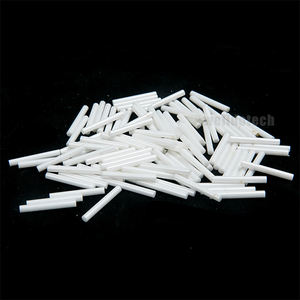
These technical ceramics consist of α-phase aluminum oxide (Al₂O₃) with purity levels ranging from 95% to 99.9%. Industrial-grade blocks (95-99% Al₂O₃) contain silica and magnesia sintering aids that enhance fracture toughness (up to 4.5 MPa·m½), while high-purity versions (99.5-99.9%) maximize temperature resistance and corrosion immunity. Standardized as per ASTM F1799, they’re manufactured in dimensional formats including 10x10x30mm blocks through precision grinding, achieving ±0.1mm tolerances for critical installations.
2.2 Performance Specifications
Key technical parameters include density ≥3.85 g/cm³, compressive strength >2,500 MPa, and dielectric strength >15 kV/mm. The material’s operational limits span cryogenic to 1,750°C in inert atmospheres, with continuous air service at 1,600°C. Unlike polymer composites or metals, alumina maintains >85% of room-temperature strength at 1,000°C due to its refractory crystalline structure that resists dislocation creep. These properties make it indispensable for applications where metallic solutions fail through oxidation or softening.
3. Production Process of High-Temperature Alumina Ceramic Blocks
3.1 Advanced Forming Techniques
Manufacturing begins with micronized alumina powder (D50 = 0.5-1.0µm) mixed with organic binders. Industrial blocks are typically formed through dry isostatic pressing at 100-200 MPa, creating near-net shapes with 55-60% green density. For complex geometries, injection molding with thermoplastic carriers is employed. Critical to performance is the deagglomeration process using ball mills or attritors, ensuring uniform particle distribution that prevents structural defects during sintering. This stage determines the final product’s pore distribution and grain boundary consistency.
3.2 Precision Sintering
Sintering occurs in high-temperature kilns with molybdenum disilicide elements, following precisely controlled thermal profiles. The process involves:
– Ramp-up at 50-100°C/hour to 400°C for binder burnout
– Intermediate hold at 1,100°C for 2 hours for alpha-phase transition
– Final sintering at 1,500-1,650°C for 4-12 hours depending on part thickness
– Controlled cooling at 30°C/hour to prevent thermal stress cracking
This yields components with <96% theoretical density and microstructures containing 3-7µm equiaxed grains, optimized for thermal shock resistance. Post-sintering, diamond grinding achieves final tolerances of ±0.05mm for precision applications like insulating socket parts.
4. Application Fields of High-Temperature Alumina Ceramic Blocks
4.1 Extreme Environment Solutions
In thermal processing industries, these blocks serve as furnace linings, thermocouple protection tubes, and burner nozzles where temperatures exceed 1,400°C. Their zero-porosity variants prevent gas permeation in semiconductor diffusion furnaces. The power generation sector utilizes them as electrical insulators in MHD generators and plasma torch components, leveraging alumina’s volume resistivity of >10¹⁴ Ω·cm at 1,000°C. Cement plants install them as cyclone liner blocks, achieving 3-5X longer service life than high-chrome cast iron in abrasive calciner environments.
4.2 Specialized Industrial Components
Custom-engineered blocks function as wear plates in coal injectors, preventing erosion in gasification systems operating at 25 bar pressure. The chemical industry employs ultra-high purity (99.8%) versions for reactor linings handling molten salts and strong acids. Recent innovations include their use as blank bricks in vacuum brazing fixtures, where dimensional stability at 1,200°C enables precision aerospace component joining. In materials research, they serve as substrate plates for high-temperature superconductivity experiments due to their non-reactivity and thermal stability.
5. How to Select Quality High-Temperature Alumina Ceramic Blocks
5.1 Performance Validation Criteria
Prioritize blocks with certified material properties including:
– Purity level verification through XRF testing
– Density measurements per ASTM C20 (≥3.90 g/cm³ for 99% grade)
– Microstructure analysis showing grain size ≤5µm
– Thermal shock resistance validation via water-quench testing (ΔT=1,000°C cycles)
– Wear rate documentation per ASTM G65 procedure D
Demand ISO 9001-certified manufacturers who provide batch-specific test certificates. For critical applications, request samples for application-specific validation like erosion testing with actual process media.
5.2 Design and Sourcing Considerations
Match alumina grade to operational demands: 95-99% Al₂O₃ for mechanical wear applications, 99.5-99.9% for ultra-high temperature or corrosive environments. Dimensionally, allow for thermal expansion allowances of 0.7-0.8% at 1,000°C during installation design. Source from suppliers offering customizable geometries with precision-ground surfaces where dimensional accuracy impacts system performance. For maintenance-sensitive installations, consider suppliers providing compatible maintenance protocols to maximize service life.
6. Frequently Asked Questions About Alumina Ceramic Blocks
6.1 Thermal and Mechanical Performance
Q: What maximum temperature can alumina blocks withstand?
A: Standard grades (99% Al₂O₃) maintain structural integrity to 1,650°C in oxidizing atmospheres, with high-purity variants (99.8%) usable to 1,750°C in inert environments. Above 1,200°C, gradual creep occurs at stresses exceeding 70 MPa.
Q: How do they compare to zirconia in wear applications?
A: While zirconia offers higher fracture toughness (9-10 MPa·m½ vs 3-4 for alumina), alumina provides superior chemical stability in acidic environments and better thermal conductivity for heat dissipation in high-speed wear scenarios.
6.2 Installation and Maintenance
Q: What joining methods are recommended?
A: Mechanical clamping is preferred for blocks operating above 800°C. Below this threshold, specialty silicate-based adhesives with CTE matching (8.5×10⁻⁶/K) can be used. Avoid organic epoxies above 350°C.
Q: How to surface-clean alumina components?
A: Use alkaline cleaning solutions below pH 9.5, avoiding hydrofluoric acid or strong alkalis that attack grain boundaries. For heat-treated contaminants, thermal decomposition at 600°C followed by CO₂ blasting is effective.
Tags: Alumina Ceramic Block, Al₂O₃ Ceramic, High Temperature Ceramic, Wear Resistant Ceramic, Alumina Industrial Block, Alumina Tile, Ceramic Wear Plate, Alumina Refractory

(Good Temperature Wear Resistance Al2o3 Alumina Ceramic Block )
Supplier
Alumina Technology Co., Ltd focus on the research and development, production and sales of aluminum oxide powder, aluminum oxide products, aluminum oxide crucible, etc., serving the electronics, ceramics, chemical and other industries. Since its establishment in 2005, the company has been committed to providing customers with the best products and services.
RELATED POSTS
High Purity And High Density: Unveiling The Manufacturing Process Of High-Performance Alumina Ceramic Rods
Use Alumina Ceramic Baking Dishes in High-Temperature Laboratory Crucible Applications
Alumina Ceramic Baking Dishes Are Secretly Powering High-Tech Labs (And Your Kitchen)

Pioneering the Future: High Alumina Porcelain’s Function in the Industrial Revolution with Unmatched Precision and Longevity
What Is Alumina Ceramic and Why Is It Used in Baking Dishes?