Professional Premium Aluminum Oxide Products Supplier

In the arduous world of industrial high-temperature processing, from semiconductor production to metallurgical heat treatment, furnace components are exposed to conditions that can degrade normal materials in just a few hours. As one of these crucial components, the alumina ceramic tube has emerged as an essential workhorse that is reliable, operating in extremely hot situations, where environments become corrosive and thermal shocks occur frequently. But what is it that gives these tubes their incredible durability? In this article, we will explore the fundamentals of material science, the fundamentals of design, as well as the properties that enable the alumina ceramic tubes to not only endure but flourish in harsh furnace environments.

Material Properties of Alumina Ceramic Tube
At the core of the tube’s capabilities is the substance itself, aluminum oxide (Al2O3) or Alumina. This ceramic compound isn’t a pure material but rather the spectrum of its pureness, and generally can range from 85% to 99.9 for furnaces used in industrial applications.
High Purity = Better Performance: Alumina with higher purity (e.g., 99.5% Al2O3 and higher) has fewer glassy phases as well as impurity silicate grain boundaries. This has several major advantages:
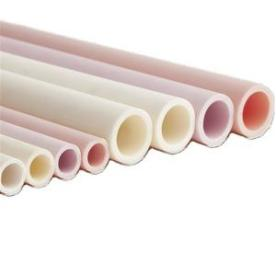
- Enhanced Refractoriness: Pure alumina has an exceptionally high melting point of approximately 2,050°C, far exceeding the operating range of most industrial furnaces (typically 1,200°C – 1,800°C).
- Superior Chemical Inertness: It resists attack from many molten metals, slags, and corrosive gases (like chlorine, sulfur, and hydrogen), preventing tube degradation and contamination of the furnace charge.
- High Mechanical Strength. In spite of high temperatures, High-purity alumina maintains the majority of its strength at room temperature, keeping it from collapsing and creep deformation under pressure.
Microstructure is the Key. The polycrystalline microstructure of sintered alumina has been designed to reduce porosity and regulate the size of the grain. A fine, dense structure acts as a barrier to gas permeation, increases mechanical strength, and enhances the resistance to thermal shock by distributing the load more evenly.
Mechanisms for Withstanding Extreme Conditions
1. Confronting Intense Heat: Thermal Stability and Low Thermal Conductivity
The primary purpose of alumina is to serve as a strong structural and thermal barrier. The high thermal stability of the material ensures its dimensional integrity – it does not melt, shrink, or swell. In addition, although it is an electrical conductor, its low heat conductivity (compared to, for instance, silicon carbide) can be beneficial for many different furnace designs. It permits controlled heat transfer and helps to create uniform temperatures within the tube, protecting external furnace parts. This prevents the creation of massive thermal gradients that can cause cracks.
2. Surviving Thermal Shock: The Art of Managing Stress
Rapid temperature fluctuations are a primary reason for the failure of ceramics. When the tube is heated or rapidly cooled, various parts expand and contract at different speeds, causing internal tension stresses. Alumina counters this by employing several mechanisms:
- Moderate Coefficient of Thermal Expansion (CTE): Alumina has a moderately lower and stable CTE that is predictable and low (around 8 10-6/K), which limits the total strain that occurs during temperature changes.
- High Fracture Toughness: Modern alumina formulations are engineered in order to improve the material’s fracture toughness, which is its resistance to the spread of cracks. This is achieved by microstructural design. Sometimes, it incorporates defects that are controlled or secondary phases to deflect the progress of cracks.
- Design Optimization The geometry of tubes (wall thickness and the radius of and transitions) along with furnace ramp-rate protocol is created to reduce the stress-concentration.
3. Defying Corrosive Atmospheres: A Shield of Inertness
A lot of high-temperature processes require reactivity and controlled atmospheric conditions (hydroge, carbon monoxide, ammonia) or involve volatile materials. The strong ionic bonds of Alumina make it chemically stable. It doesn’t further oxidize and doesn’t form low-melting-point compounds with the most frequent process pollutants. This inertness means that the tube is not a source of any impurities to the process, and also ensures the structure’s integrity even after prolonged exposure.
4. Resisting Mechanical Load and Wear: Structural Integrity
Beyond the static load of the internal or external components of fixtures, the tube can suffer abrasion as a result of the motion of the product or mechanical stress caused by supports. High-purity alumina is extremely tough (9 according to the Mohs scale, which is just below diamond) and provides an excellent wear resistance. Its strength of compression is high, allowing it to take on substantial static loads at extreme temperatures.
| Property | High-Purity Alumina Tube (99.5%) | Mullite Tube | Fused Quartz Tube | Silicon Carbide Tube (Sintered) | Why Alumina Wins for Many Furnace Apps |
|---|---|---|---|---|---|
| Max. Use Temperature (°C) | 1,750 – 1,800 | 1,500 – 1,600 | 1,200 | 1,500 – 1,600 | Higher maximum temperature capability. |
| Thermal Shock Resistance | Good | Moderate | Excellent | Very Good | Balances high temperature with good shock resistance. |
| Chemical Inertness | Excellent | Very Good | Good (but attacked by alkalis) | Good (oxidizes in air >1,400°C) | Superior broad-spectrum resistance to melts and gases. |
| Mechanical Strength at High T | Excellent | Good | Poor | Excellent | Best strength retention at very high temperatures. |
| Electrical Resistivity | Excellent Insulator | Excellent Insulator | Excellent Insulator | Conductive/Semiconductor | Essential for electric furnace elements and insulation. |
| Cost & Machinability | Moderate / Difficult | Moderate / Difficult | High / Difficult | High / Very Difficult | Offers optimal performance-to-cost ratio for high-end use. |
Beyond the Base Material: The Role of Manufacturing
The unique properties of the alumina powder can be fully achieved only by precision manufacturing. Isostatic pressing is the most common method of producing high-performance tubes since it uses uniform pressure in all directions, creating an uniaxially pressed tube that has a uniform density, a low anisotropy, and superior mechanical characteristics to the uniaxially pressed alternatives. Sintering, which is a high-temperature fire process, is carefully controlled to create the desired fine, dense microstructure with no flaws.
In addition, post-processing techniques like precision diamond grinding can ensure precision in dimensional tolerances and a smooth finish. A smooth interior surface decreases the areas where contaminants can adhere and also reduces friction between parts that are inserted.
Application of Alumina Ceramic Tube in the Manufacturing Industry
The distinctive combination of properties makes Alumina tubes the liner muffle, or chamber of choice for:
- Semiconductor Diffusion/Oxidation Furnaces: Where ultra-purity and contamination control are paramount.
- Thermocouple Protection Sheaths: Shielding delicate sensors in molten metal and aggressive flue gases.
- Vacuum and Inert Gas Furnaces: Maintaining integrity in low-pressure or controlled environments.
- Aerospace Component Heat Treatment: For processing superalloys and advanced composites.
- Research & Development Labs: Where process conditions are variable, and material reliability cannot be a variable.
Conclusion
Alumina ceramic tubes are far more than simple containers; they are engineered solutions to some of industry’s most severe thermal and chemical challenges. Their ability to withstand extreme furnace environments stems from a powerful synergy: the intrinsic high-temperature stability and inertness of the alumina material, enhanced by advanced manufacturing techniques that optimize microstructure and geometry. By providing a reliable, pure, and robust environment for high-value processes, these tubes form the silent, stable backbone of modern high-temperature manufacturing, enabling innovation and quality across countless industries. When furnace conditions reach their most extreme, the resilience of alumina ceramic tubes ensures that the process continues, safely and efficiently.
Supplier
Alumina Technology Co., Ltd focuses on the research and development, production, and sales of aluminum oxide powder, aluminum oxide products, aluminum oxide crucibles, etc., serving the electronics, ceramics, chemical, and other industries. Since its establishment in 2005, the company has been committed to providing customers with the best products and services. If you are looking for high-quality alumina ceramic tubes, please feel free to contact us.
RELATED POSTS
Aluminium Doped Zinc Oxide Thin Films
The Chemical Of Aluminium Oxide